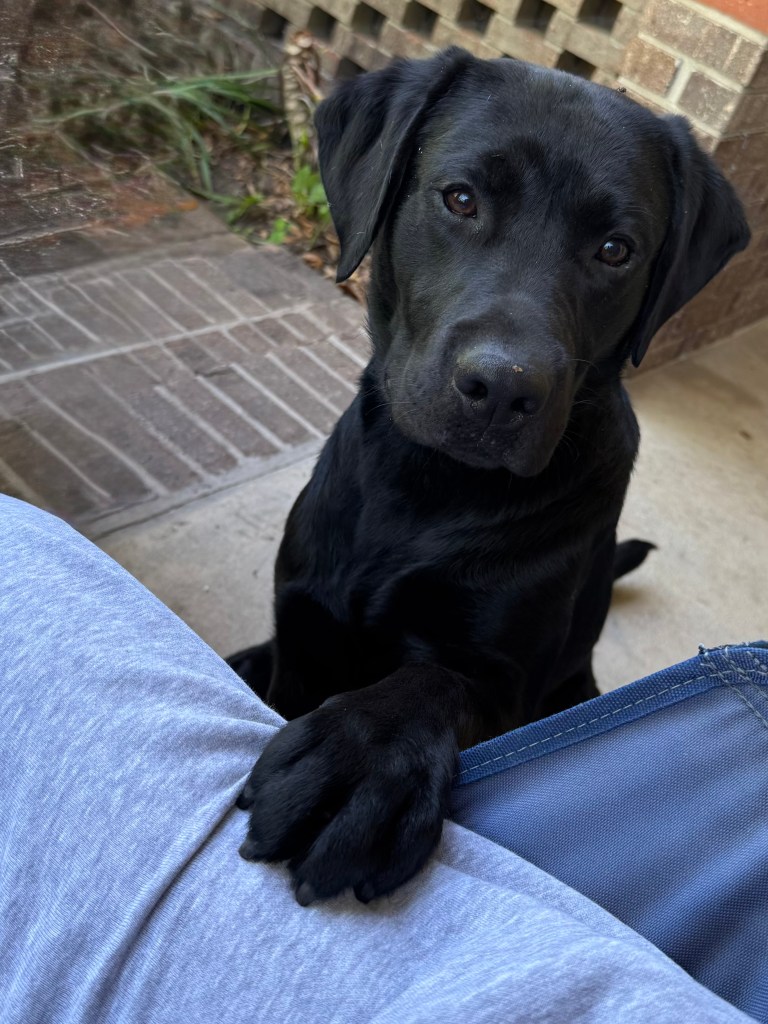
I think I smell something…
Duke is learning to be a diabetic alert dog. These dogs will smell blood sugar changes in anyone – their handler or even someone they don’t know!
Duke is alerting in this picture because he smelled a low blood sugar. Even though Sara isn’t with him right now, she provided scent samples (basically saliva on a cotton roll) which smells like a specific blood sugar result. These samples are taken and then a fingerstick is performed to know if it’s a high or low sample. Erin gets the sample out and Duke is trained to smell it and paw to alert her. Some dogs will paw, some will nudge and others may boop with their nose to get their handler’s attention. Duke and Snook will paw for their trained alert.
I have read that dogs have a natural alerting behavior in a pack. Snook has done a couple of natural alerts that were never taught to him. Most likely, Duke will do a natural alert and I will get to see it but I don’t know when. Snook’s natural alerts were to lay on my feet so I couldn’t walk forward (that happened twice) or “body block” me so if I wanted to move forward I would have to go through him.
A dog’s nose is nothing short of extraordinary—it’s one of their most powerful tools! To put it into perspective, their sense of smell is estimated to be 10,000 to 100,000 times more sensitive than ours.
Here’s why their noses are so impressive:
- High Sensory Receptors: Humans have about 5-6 million olfactory receptors, while dogs have up to 300 million, depending on the breed. This gives them a significantly sharper ability to detect scents.
- Dedicated Brain Power: The part of a dog’s brain devoted to analyzing smells is about 40 times larger than the same region in a human brain, relative to total brain size.
- Separate Airflows: When dogs sniff, part of the airflow is used for breathing and part is directed to their olfactory sensors, ensuring a constant stream of smells for analysis.
 Let's Train Duke